Mile Zero is the personal website of Thomas Wilburn. All statements and opinions here are my own, and do not represent the views or policies of my employers at Congressional Quarterly, Ars Technica, or other publications.

February 16, 2010

Recombinant

You may have heard that there was a blizzard last week, trapping the entire East coast indoors for about five days straight. Walking the dog in the morning after a big snowfall was like stepping into an apocalyptic movie cliche: howling wind, half-buried automobiles and buildings, and no sign of other life to be found. Even for a misanthrope like me, it was a little creepy. Belle started to go stir-crazy around day 2. I lasted a bit longer, but by Wednesday I needed something to do that wasn't beamed through an LCD screen, so I broke out my bass and pedals for the first time in a while, and started rearranging things.

For the serious pedal-head, it's possible to enter a kind of trance-like feedback loop while searching for new sounds: you shift between playing a lick, twiddling a few knobs, and listening intently to determine whether the new sound has moved closer to the ideal in your head. Play, adjust, listen, rinse and repeat. And there's no better way to trigger this kind of behavior than to scramble the order for your pedals and randomly activate a few of them--it creates a totally new sound, acts like a mental reset button. My drug of choice, of course, is distortion, and my current favorite is the Z. Vex Woolly Mammoth that replaced an MXR M-80 Bass DI+. Since picking up the Mammoth, I'd put the MXR on a shelf temporarily, but addled by the snow and the confines of the apartment I decided to put the two of them in series and see what kind of overdrive I could get.

The Mammoth doesn't like hot input from a preamp of any kind, pedal or bass, so the first experiment with the M-80 first in the signal chain didn't work out. And running the Mammoth into the M-80 with the usual distortion settings on both was interesting--it triggered a kind of overcompression effect--but the distortion from the MXR (which was once semi-accurately described to me as "bees in a tin can") was washing out the low-end from the Z. Vex. But when I kicked off the distortion and just tried the SVT-emulating clean channel on the M-80--wow. The preamp took the Mammoth's fuzz, thickened it and tamed some of the high-end. It was monstrous, and very cool, and I played with it for probably an hour and a half until I had it tweaked perfectly and my fretting fingers were sore.

The lesson here is not that I've got a new bass distortion that can level continents, although that's a nice bonus. It's the process of serendipity that got me there: being able to rewire or adjust my pedals in possibly stupid or odd ways, just to see what would happen. A good toolkit gives you that kind of freedom. That's one of the reasons I'm so keen on single-purpose effects boxes: multi-effects are just now reaching the level of sophistication that allows something as simple as shuffling the order of the signal chain, and they rarely make it fast or easy. A multi-effects unit is good if you already know what you want, but it's murder on creativity.

When I think about it, this is true for most of the tools I like to use. Javascript and PHP are ungainly, hackish languages, but the flexibility of loose typing and hash-based objects makes it easy to throw data around and see what sticks. Pro Tools is a mess from the perspective of plugin APIs and efficient resource use, but its flexible routing mixer is unmatched for patching audio around in a project. I remember first falling in love with word processing when I realized that you could move paragraphs around instantly--no more endless recopying drafts (and how I hated teachers in grade school who required handwritten reports). And we won't even get started on my unhealthy MacGyver obsession.

The Make crowd tends to say that you don't own a tool unless you can hack it. I think it's also a question of convenience--how easily can you surprise yourself when patching something together? When Mark Pilgrim wrote Tinkerer's Sunset, reminiscing about how he got started on an Apple IIe, the gateway was BASIC. And while computer scientists hate BASIC for the bad habits it spawned in a generation, it had one thing going for it: it's really easy to read and understand, as the programming equivalent of Choose-Your-Own-Adventure books. The only modern language with an equivalent level of ubiquity and cost is Javascript, and even it is much more difficult for a newcomer to grasp. It's harder to rewire it, harder still to find a serendipitous solution.

Or take electronics: when I was a kid, which was not that long ago, you could still take apart a stereo or a TV and see all the wires and bits inside. You could still blow a circuit breaker poking around in there, even if you never did understand what everything was (I speak from experience). Nowadays, it's all disposable system-on-a-chip engineering, even in an industry as low-tech as music. Those analog pedals of mine are a dying breed, and while I'm as big a fan of digital as you'll find, I hope there's room for both. The Z. Vex Inventobox and the Arduino are responses to the rise of black-box hardware, but they're also tacit admissions: that we have to special-order creative tools, separate from those designed for media consumption and ease-of-use.

I hope we don't lose the idea that it's possible to combine the two. You can have tools that are easy to use and easy to hack, even if we're told by designers that it has to be one or the other--that letting people open up the box would make it too complicated for the average user. Maybe it just takes a new model. If so, I nominate the humble, patchable, routable effects pedal. Because hey, if guitarists can learn to use them for boundless creativity, anyone can.

October 19, 2009

Two Cans

For years, I listened to music through the cheapest headphones I could find. This usually meant those $10 Sony earbuds, the awful plastic ones that leave your ears physically sore and boast of "deep bass" (read: less midrange). But since I was pretty much broke all the time, and rarely bothered to bring my CD player anywhere anyway, the earbuds had to do.

I didn't buy better phones until a few years after I started working with digital audio. While I was at the World Bank's Multimedia Center, the standard for all the video stations was Sony's MDR-7506 (or its original variant, the MDR-V6). The MDRs have been pretty well-known professional units for years--they're staples of mastering and post-production studioes--and lots of people hate them, saying that they're unsubtle and overly bassy. All of which is probably true, but they were miles above anything I'd used before. Suddenly I could hear all kinds of distinct parts in the music that had previously been masked by poor equipment. It was eye-opening, like the first time that I used a condenser mike instead of a dynamic.

Today I own three sets of nice headphones. I have a set of MDR-7506s for work, a Beyerdynamic DT 770 for those increasingly rare times that I do audio editing at home, and some Etymotic earbuds for portable use. I'd say these are reasonably-priced now--only the 770s cost more than $100--but there's no way I'd have seen them as "affordable" during my painful-plastic-earbud years. Which is not to say that I couldn't have saved up for a pair, but it would have been hard to convince me to do so, since I had no exposure to anything better.

Most people, I assume, are basically in the same position. Surely that's the only thing that can explain the proliferation of those awful white earbuds on the Metro. It's a catch-22: the only way people would consider better cans would be if they listened to them, and that probably won't happen until they actually buy a pair, which they won't do because they've never heard good headphones and can't justify the expense.

Some may argue that digital compression makes headphone quality irrelevant, and that could be true in some cases. But at modern bitrates, psychoacoustic compression isn't nearly the sound-muffler that it was during the Napster days. To the extent that it has an impact, compression is way less harmful than a poor speaker setup.

So this is a plea to all those people I see on the train with $10 headphones plugged into a $200 music player (or worse, using the pack-in earbuds). I feel your budgetary pain, guys, I really do. But the next time you feel the urge to upgrade, consider putting the cash into the other end of the headphone cord. I'm pretty sure you'll appreciate it.

May 28, 2009

Consider the Mammoth

Part of an ongoing series obsessing over effects pedals. Other posts in this series concern the Line 6 PodXT Live, MXR M80 Bass DI+, Line 6 DL4 delay/looper, Boss LS-2 Line Selector, DOD FX25B Envelope, and Z-Vex LoFi Loop Junky.

Whenever I talk about distortion, the Wooly Mammoth has almost always surfaced at some point. I've wanted one for years--it had a near-legendary status among the fuzz addicts in the Lowdown forums when I first started learning bass. I salivated over the demo video. But I didn't actually get a chance to try it out until I was in Portland, and I ended up buying the Loop Junky instead. Luckily, it turns out there's a thing called the Internet that lets you order pedals from far-away locations, so eventually I picked up a Mammoth as well.

The Wooly Mammoth is, no kidding, basically the greatest bass distortion of all time. It's also kind of an oddball pedal. When Bass Player did a big effects issue a while back, they called the Mammoth an "archetypal boutique stompbox" with an "eccentric" circuit, and they weren't kidding. It doesn't like hot or low-impedence inputs (read: active basses), it lacks a blend function, and two of the knobs are labeled "pinch" and "wool." Chords may emerge mangled, especially triple-stops. Crank the wool too high, and it actually begins to feed back on itself somehow, self-compressing and adding weird harmonics. In short, the Mammoth, like the Loop Junky, has character.

Still: all is forgiven for a fuzz like this. It nails the bass sound from 'Hysteria' by Muse: that thick, chainsaw-like roar, but with each note perfectly distinct. The gating comes partly from the Pinch knob, which does something unholy to the distortion harmonics and eventually turns the fuzz into a square-wave synth. It's also immediately obvious why the Mammoth doesn't have a blend function: you don't need it. This is the first distortion pedal I've ever seen where the signal emerges with more low-end, possibly due to some kind of octaver/synth effect. I'm not sure how it happens, frankly--like I said, it's a weird circuit--but I'm glad it does.

This is becoming uncomfortably fawning. Perhaps it's appropriate to raise the question of cost: of course it sounds good, it's a ridiculously expensive piece of equipment. But is it really that much better? Is there an excuse for spending so much money for a single pedal? Indeed, these questions expose three facts you may want to take into consideration. First, I'm a distortion nut, so I can justify a lot in the name of a good fuzz. Second, I mostly play solo, so I don't have a lot of sonic competition or cover. Finally, anything this expensive often provokes a defensive attachment that's out of proportion to its actual worth.

More importantly, the above questions highlight a real conceit for many modern musicians: the idea that we're buying these gadgets for anything but our own satisfaction. With a very few rare exceptions (Bootsy's envelope filter, the ping-pong delays of the Edge), chances are the audience can't tell the difference, or bring themselves to care (those that do care are usually musicians themselves, and that way madness--or Steve Vai--lies). It's not to say that nice gear is a bad purchase, but it is a reminder of a truth that many of us sometimes forget: in the end, it's really about the song and not about the gear.

I like the Mammoth very much, and I'm glad I picked it up. It's far more fun than my MXR fuzz, although I miss the M-80's clean channel. But I'm under no illusions here--I know that it's on my pedalboard just for me. And at some point, I've got to start writing some new tunes, instead of just playing the old ones through new equipment, because that--and not the contents of a signal chain--is the real measure of a musician.

March 17, 2009

POD People

Part of an ongoing series obsessing over effects pedals. Other posts in this series concern the MXR M80 Bass DI+, Line 6 DL4 delay/looper, Boss LS-2 Line Selector, DOD FX25B Envelope, and Z-Vex LoFi Loop Junky.

There are three pieces of Line 6 gear in my collection: the DL4 (possibly retired), the Variax Bass, and the Pod XT Live. Of the three, the last is probably the only one I'd recommend without exception. It's also descended from the most important musical product that Line 6 ever made, one that can legitimately claim to have changed the industry.

In 1999, Line 6 introduced the first Pod, named because it was a thick, red, kidney-looking thing. Its purpose was to provide a virtual guitar signal chain in one unit: pedals, preamp, power amp, and speaker cabinet. Later models added microphone and acoustic simulations to the mix. The Pod wasn't the first modeling processor--Roland's been making them for years, among others--but it took off in a way that its predecessors didn't, probably because its controls directly mimic the modeled amplifiers, making it simple enough for guitarists to use. Pods found a niche in a lot of home (and some pro) studios, as well as being used sometimes for live musicians that wanted flexibility onstage. They've gotten a lot better over the last decade: I know guitarists can be picky about them, but they sound eerily accurate for my purposes.

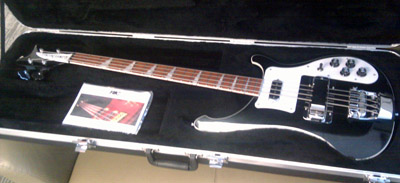
The Pod XT Live is the second or third generation of these modelers (depending on how you count--there's both a Pod 2.0 and a Pod XT series before the Pod X3), and it integrates a floorboard into the design. Run it straight into a power amp and a relatively flat cabinet, and it's a cover song machine--particularly with the Variax, which links up digitally to the Pod. I've set up flattering amp and effect combinations for my favorite bass models: a Jazz bass through a GK amp (my general-purpose rig), Rickenbacker through an Ampeg stack (great classic rock/punk sound), Stingray with a scooped Sunn/4x10 combination (for slap), and a few crazy models (like the twelve-string into an ultra high-gain "lunatic" amp). Even though I don't lust for amps the way I do for effects and instruments, I could still tweak the settings on these all day long. It's terribly addictive.

That said, the Pod isn't important because it lets me sound like Geddy Lee when I want to play "Limelight." It's important because it represents the democratizing effects of modern music technology. A pedalboard Pod like this will run you about $500 if you want the latest version, and you can knock off a couple hundred if you settle for scratch-and-dent stock of the previous generation. That's roughly 1/2 to 1/3 of the cost of one of the cheaper amps it models, and for amateur recording purposes it's probably a better deal--after all, most people can't crank up a Dual Rectifier in their apartment anyway, and the sound would be terrible if they did. Modeling tech might not make you Rick Rubin, but it gets you close enough. And while you can pull a lot of the same tricks with a $100 audio interface and a VST host, it's nowhere near as simple or foolproof as a Pod--trust me, I've tried.

I'm not really advocating that everyone should be aiming for slick production, of course. I'm a huge fan of messy, unprofessional recordings (audience: "You would be!"). But look: sometimes you just want a decent guitar or bass sound, and you don't want to fiddle around with expensive microphones and amplifiers and acoustic spaces for hours--or you can't afford to, in terms of time and/or money. I don't think you should have to, the same way that nobody should have to find an echo chamber or a plate reverb unit in the age of digital delay and 'verb units. Musicians should be able to cut straight through to making music. For me, that's when the Pod really comes in handy.

February 6, 2009

Do Not Hold in Hand

Part of a series of meandering, tedious posts about the effects I use to make music. Other posts in this series concern the Line 6 DL4 delay/looper, Boss LS-2 Line Selector, DOD FX25B Envelope, and Z-Vex LoFi Loop Junky.

In addition to the obvious sonic convolution, a good pedal delivers a kind of emotional kick when activated. It comes from a combination of the cultural context associated with the sound (the 70's swagger of a wah, the jazz-club cool of a chorus), the short thrill of sudden change from one sound to another, and the intrinsic appeal of the effect itself on an individual. Everyone has one kind of effect to which they respond strongly. For me, that's distortion. There's something about the sharp, rich, aggressive roar of a high-gain fuzz pedal that puts a huge grin on my face every time I switch it on.

As usual, unfortunately, bass players face particular challenges when looking for a good distortion. Not only do effects designers seem to see the instrument as unworthy (or unprofitable) compared to the guitar, but bass frequencies often don't play nice with stompboxes: either the results are muddy and indistinct, or all the low end is hollowed out--or, in the case of distortion pedals, possibly both. Some bassists, like Amy Humphrey from Clatter, get around this by splitting the signal between an overdriven guitar amp and a clean bass amp. Sadly, for budgetary and volume reasons, this is not an option for most of us.

I've tried a lot of guitar-oriented distortion pedals, looking for the kind of "assault by wrathful deity" quality that makes me happy, and often came up short. The worst, by far, was a DOD Grunge pedal that made my bass vanish in the mix completely. I'm not alone in hating this pedal. Kurt Cobain is rumored to have been given one as a joke, and he loathed it so much that he lobbed it into the crowd at a show. At the other end of the spectrum, the ProCo Rat had a decent bass sound--literally, a decent sound. The Rat is not known for versatility, and while I'm not a fanatic about flexibility in my pedals, it's nice to be able to tweak things at least a little.

I've had better luck with the relatively few distortion pedals made specifically for bassists. What's different? In general, these units add a blend control, so players can mix in the original bass signal, thus replacing the low frequencies and transients missing from the distorted signal path. As a strategy, this is often a mixed success. One of the first distortion pedals I was actually happy using, the Digitech Bass Driver, somehow managed to produce a "blend" that sounded more like a clean bass and a very fuzzy bass playing side-by-side, perhaps due to a very sterile-sounding digital mixing bus (although Boss's all-analog OD-3 bass distortion shares this problem, in my opinion). Bass distortion pedals may also tune the distortion differently, hoping to add an edge without fuzzing the sound out completely.

The distortion pedal I use now, an MXR M-80, is a good example of success via attrition. It's still not quite my platonic distortion ideal, but it's been better than the other contenders so far. The fuzz is brash but controllable, thanks to a workable blend and a noise gate that tames some of the inevitable hum at the super-high gain settings I like. I'd prefer a parametric EQ, but the existing controls--with the mid boost centered at around 800Hz--do an effective job in getting different sounds, or adapting to different acoustic spaces. All in all, a decent distortion that does what I need it to do.

That said, the killer feature of the M-80 is that it's a two-channel unit: in addition to the distortion, there's a "clean" setting that runs the bass through the pedal's preamp and EQ system. If you press the "color" button next to the clean volume knob, it adds a preset EQ scoop that (to my ears at least) turns my single-coil jazz bass into something more like a Stingray or Sterling humbucker, perfect for slap bass and percussive looping. I could make do without that preset--loop-based musicians soon learn to pull different tones out of the instrument with just their hands--but it does make my life a lot easier. Any distortion pedal that takes over from the M-80 will have to be truly fearsome to make up for the loss of that second channel.

Still, like I said, I think everyone has one kind of pedal that appeals to them on a deep, irrational level, so I don't expect that I'll ever stop looking--or, as with the virtual pedalboard experiment I tried about a year ago, attempting to mix my own. I imagine it's something like what drives hot pepper fanatics, always on the lookout for a new capsaicin thrill. It's hard to explain to non-addicts--either of the pedal or the pepper variety--but maybe for these kinds of simple pleasures, it's best not to try.

January 21, 2009

Requiem for a DL4

The Line 6 DL4 delay modeler occupies an enviable position on the pedalboards of a lot of musicians, both famous and not. It's considered by many to be not just one of the best delays available, but also one of the best loopers for the money. At the same time, it has a well-deserved reputation for unreliability. Even though it's been a decade since the pedal was first introduced, Line 6 hasn't ever produced a hardware revision to fix those issues. Why would they? The combination of the two means that a lot of people have bought DL4s several times over.

I am, in general, a fan of Line 6. Their modeling tech is impressive, and it's relatively affordable. More importantly, I usually find that they understand the ways musicians will use their products more than a lot of prosumer music companies do. So it's frustrating when an issue like the DL4's fragility goes uncorrected for so long--and it's really frustrating when the flaky DL4 in question is mine. I'm not keen on paying for another faulty unit (or driving it up to Maryland for a costly repair job), but it's hard to find anything that can replace the Line 6 at anywhere close to the same price.

Don't get me wrong, there are lots of loopers under $500 that beat the DL4 on a spec sheet. Boss has a whole set of pedals with longer sample lengths, or the ability to save samples for later. Its largest model can play multiple loops simultaneiously. Digitech's JamMan even records its audio to CompactFlash cards, so you can load arbitrary sounds from a computer. Either one of these, just to take two examples, is also much more durable than the DL4.

But neither of them is anywhere as usable for real-time looping. On both, for example, there's no way to go directly from the first recording pass into an overdub pass. The JamMan requires a double-stomp to enter overdub mode, which is much harder to time correctly, and the Boss pedals typically require playback to begin before overdubbing (the exception is the RC-50 pedal, which is A) enormous and B) only allows users to replace the default behavior, not make a decision at runtime). The great thing about the DL4 is that you don't have to make a choice--you can start with an overdub right away, or you can go straight into loop playback.

The same kind of thinking--or lack thereof, for other pedals--shows up in the one-shot feature. On other loopers, the option to play a loop just once (like a triggered sample) is usually set via a small switch on the actual unit, and it can't be changed while the loop is playing. In contrast, the DL4 has a switch set aside just for arming "Play Once" mode. At first, this seems like a waste of hardware, but don't be fooled: that switch is tremendously useful. It's not just good for the obvious applications of trigger-and-forget sample playback. You can also use it to tell the looper that you want playback halted automatically, freeing up your feet to make changes on other pedals at the same time. And if you're really good, you can use its ability to restart loop playback for compositional tricks that aren't otherwise available.

In other words, what you get with the DL4 isn't the most fully-featured pedal. But the designers have made sure that every feature it does have is accessible with one step at all times. If you're playing a looper as an instrument, and not as a foot-mounted samplebank, that's arguably far more important. Any time you have to reach down to adjust an option, or let a sample play through in order to get a proper overdub going, you've broken the performance.

When the DL4 started acting up, losing power or freezing onstage, I went looking for alternatives. The only one I've found with any potential is the Eventide TimeFactor, which offers overdub/play flexibility out of the box. Even then, to get a decent one-shot mode you have to add an external switch--but it at least gives the impression that it was designed with real-world users in mind. This may seem like faint praise (and it is), but it's something I think you can only rarely say about effects boxes. Why this is, I'm not sure. I suspect that the margins are too thin, and the consumer data too sparse, to provide proper incentives at the lower end of the market.

Frankly, when it comes to pedals gone bad, there are few good choices. Repair in our throwaway culture is expensive and hard to find. Reuse is a nice idea, but unlikely in practice, since I don't really have the technical background or patience for DIY pedal-making. And with commodities this expensive, the cost for a replacement is a bitter pill even in the best of times. In a rough economy like this, it's even harder to swallow.

Still, I'm trying to become less prone to fix problems through additional consumption. So if the choices are bad, perhaps the point is to find new ones. I still have looping tools available to me--the Loop Junky or a Mobius-based laptop rig. And I'm hoping this will serve as a reminder of why I started playing with loops in the first place: not just that I'm a misanthrope, but as a set of constraints for channeling my creativity. I like the DL4, but I'd gotten comfortable with it. Its constraints weren't really limitations anymore. It's probably time to find new ones.

December 22, 2008

Review: Edirol R-09 Audio Recorder

A $300 handheld audio recorder is a hard sell to someone who isn't pretty crazy about sound gear. And frankly, for people who are audiophiles, it could still be a hard sell--why bother spending that kind of money on a single unit with built-in electret mikes, when it could buy a decent condenser and an SM57?

I bought the R-09 when I started at CQ, thinking that it would be useful for loaning to reporters. It's worked well for that--most journalists, when they buy a recorder, pick up one of the cheap voice/memo units, which sound awful and aren't terribly sensitive. For close-up work, that's fine, but it quickly becomes unusable in, say, a committee chamber. Reporters who borrowed the Edirol really appreciated its ability to capture quiet voices in poor acoustic spaces. One even bought his own after he found himself borrowing mine on a regular basis. It's also an easy device to use, which is important for non-technical people like the average journalist, and is sadly not true for all portable recorders these days.

Of course, the main goal for a unit like this--and the reason that you'd buy it over a set of separate microphones--is to use as a field recorder for quickly capturing sound without dragging a ton of equipment around. As such, a slight lack of fidelity is acceptable, since it's not like you'd be using a U47 to get a sample of street ambience anyway. That said, I don't have any complaints about the quality of the R-09's recordings. They seem relatively flat (EQ-wise) to me, the gain is adequate, there's not much self-noise or handling noise, and the stereo separation is surprisingly good. Recordings I did of union protesters on K Street a while back were clear and offered a great sense of space. More importantly, it's fast enough that I could capture something like a protest if I just ran into it--nothing to hook up, unless I want to plug a pair of headphones in to double-check the sound. Just pull it out of my bag, turn it on, hit record once to set the levels, then press it again to start recording.

That kind of convenience actually means that I've started using the R-09 for jobs where it probably wouldn't have been my first choice before. At CQ, unlike at the World Bank, I don't have the luxury of a studio with a selection of vocal mikes all set up and ready to go whenever I need them. While working on the debt explainer, I recorded Kerry with an ElectroVoice RE-20, which is a fantastic vocal mike, and myself with a Sony lapel mike. She sounded fine, I sounded awful, but I didn't want to drag all my recording gear down to the quiet room again to get a punch-in take. So instead, I carried the R-09 down to record a few lines, brought it back after each take, and imported the WAV files directly into Cubase. Because of the omni pattern, the resulting takes have a bit more room noise than Kerry does, but it holds up surprisingly well against the more expensive microphone, and the workflow was much more efficient and flexible.

Compared to the other prosumer field recorder I've used, the Marantz PMD-660, the Edirol unit is a lot smaller and a lot simpler. The Marantz was capable of doing rudimentary editing tasks, like tagging and file splitting, that the Edirol just doesn't do. It also boasted full-sized XLR jacks instead of the 3.5mm TRS minijack on the R-09, which was great if you wanted to use a external mike without an adapter, but if you didn't carry a mike, the internal microphones on the Marantz were genuinely terrible. So for certain applications--portable film recording, for example, or crewed radio production--the Marantz makes sense (and from its control layout, I suspect it's more aimed at those markets anyway). There's also a durability factor--the PMD-660 could probably be used to hammer nails between recording gigs. But for $300 less, the R-09 has been a really helpful tool that I'd recommend to anyone who either wants to step up from basic recorders, or needs to be able to capture sound at a moment's notice.

December 17, 2008

The Other Kind of Loop

I enjoyed writing about the Loop Junky and DOD Envelope pedals from my collection last month. I think I'll keep doing it every now and then. I don't own any really amazing or exotic hardware, but I find that there's a shortage of decent commentary on non-boutique effects. Most of the discussion on them is at places like Harmony Central, a site that illustrates both the best and worst of crowd-sourcing, and could provide months of mockery (sample quote: "Even though i just tried it out in the store i can tell that it's not reliable." Someone get that man an engineering job!).

So if we're going to add to the Internet's collective wisdom on entry-level stompboxes, why not start with the one pedal that makes no noise on its own, that few people would consider, but should be one of the building blocks for any compulsive pedal-purchaser: the Boss LS-2.

The LS-2 is basically a foot-switchable, floor-mounted, battery-powered mixer. It's hard to understand the appeal of such a thing until you've used one--what's the point of a pedal that just connects other pedals? Leave the mixing to the sound guy! But the LS-2 isn't really just a mixer. It's a swiss army knife for musicians. It solves problems. And when you buy effects on a budget, you usually find yourself with problems that need solving.

Say you've got a pedal that's got a fantastic tone, but it creates a dip in volume: leave it running through the LS-2 with the mix gain up, and swap its loop in instead of activating it directly. Alternately, you've got a pedal that sounds great when cranked, but you want it to have that sound at unity gain: the LS-2 can act as a trim for it. Noisy pedals can be isolated in the same way. Your distortion (or other effect) doesn't have a wet/dry mix control: now it does. You want to be able to bring in multiple effects with one step, mixed together at arbitrary volumes: no problem, it can do that too. Multiple instruments into one amp (switched or mixed), selective multi-amp output, muting continous effects without halting them, or just quick volume presets, it's a versatile device. The one thing I haven't been able to figure out so far is how to get it to swap a pedal from one place to another in a signal chain, but it's probably possible somehow.

Of course, you can also use the LS-2 for its original purpose of routing signals from one place to another, and that's a valuable education in its own right. After all, having lots of effects is easy--it just requires too much money. But using them effectively means learning how to order them, and how to bring them in and out of the chain for a musical purpose. That's a lot harder to learn, yet it's a skill that's emphasized over and over again in audio. Unlike video or graphics production, which (in my opinion) stresses the composition of distinct elements as layers, audio is about basic operations processed in series and parallel, resulting in a final mix. Experiment with the LS-2, and you'll have a head start on thinking about production and synthesis.

My favorite routing use for the LS-2 is as pedalboard master controller. The ability to swap entire effects loops in and out basically gives you the instant complexity of multieffects patches combined with the flexibility and accessibility of individual stompboxes. For example, I used to run the MXR Bass DI+ and a chorus on the A loop, and a second distortion into an envelope on the B loop. By turning the pedals inside each loop on and off, and then switching between them, I could get from clean sounds to combinations instantly, or even switch between two very different signal chains, just like changing a patch--and yet, I still had all the knobs right in front of me for on-the-fly adjustments. It's the poor man's M13.

There are two things that are good to know when planning signal chains with the LS-2. First, the gain controls are on the return side of the chain, which is as it should be--otherwise it would be impossible to boost or cut volume-sensitive effects like distortion or envelope. Second, the send and return sides don't technically have to form a circuit: the active loop dictates where the input signal goes and which return is routed to the output, but they only have to connect if you want them to. The cases in which they don't are a relative minority, true, but they're useful edge cases regardless. Just off the top of my head, I can imagine using it to patch in a drum machine that lacks passthrough inputs, or to feed a recorder/house mix at an arbitrary point in the chain (say, before any reverb). Sure, there are better tools for doing that kind of thing, and if you have them handy, you should use them.

But if you don't... well, that's why you have the LS-2. It's the MacGyver of guitar pedals. It solves problems and makes useful stompboxes even more useful. And that's why it's one of the few items in my box o' gear that I would instantly replace if it were unavailable.

November 14, 2008

Ode to the FX25B

While I'm rhapsodizing about unreliable analog effects, let's take a moment to reflect on the humble DOD FX25B Envelope Filter.


(I had to recolor this one to be green in order to match the physical pedal. For some reason, DOD's image is blue. This is not the worst sin committed by DOD's website--among other things, it sorts the pedal lines into categories like "Wrath of DOD" and "DOD is Love." Also, they have a Yngwie J. Malmsteen signature pedal, which I believe is actually considered a dangerous munition for the purposes of export.)

Put it this way: the FX25B lives up to DOD's hard-earned reputation as a builder of cheap, oddly-designed, unsubtle effects pedals*. The "blend" knob (added as a nod to the bassists who mostly bought the original unit, hence the "B" in FX25B) is not really a blend so much as a dry signal cut--keep it at 9 o'clock if you want any bass at all. The sensitivity is, sorry to say, way too sensitive, and usually has only one useful position, which (for me) is about 98% of the pot's available throw, and has to be precisely tweaked. Oh, and best of all, activating the pedal causes a volume drop of 20%, give or take.

And yet, with all those caveats, I always come back to this little green monstrosity whenever I want an envelope filter, because I can't get anything that will quack in quite the same touchy, uneven, delightful way. I've tried using Boss autowahs, a Bass crybaby, a regular wah, Digitech's bass synth, every Mu-Tron and generic envelope emulation in the Pod, and a gaggle of squawking VST effects--none of them give me the sound in my head as well as the FX25B. Not bad for a pedal that goes for ~$15 on eBay.

Little effects pedals like this are often called stompboxes, for the simple reason that they're metal boxes that you stomp on to activate them. But I love the word stompbox because it really sounds like something a little garish or unrestrained, and I myself am not a restrained effects consumer. It's like in every multi-FX unit review, the writer invariably calls the presets "showy" and "extreme"--I'm the guy who thinks those presets are awesome, and keeps them around just in case. It goes to show how individual sound choice can be, and why a pedal that can seem as profoundly silly as the DOD Envelope Filter is nonetheless one of my favorite stompboxes from my collection.

Or maybe there's just no accounting for taste.

* A quick key to the range of mainstream pedal manufacturers: if you want uninspired but reliable sounds, buy Boss. If you want incredibly cheap, flimsy, over-the-top crap, get one of those plastic Danelectro units. If you can't make up your mind between the two, you're a potential DOD customer.

November 13, 2008

Wow and Flutter

These two words, wow and flutter, describe the charming warble created by variations in speed on an analog tape recorder. Believe it or not, those are technical terms. You've probably heard the phenomenon, even if you don't know it--it's the way that cassette players (back when people listened to cassette recorders) or old TV episodes slip slightly off pitch.

Whenever there's a technical flaw in audio equipment like this, it inevitably ends up being stretched in two directions. Obviously, when tracking musicians, engineers try to minimize the amount of wow and flutter so that the recording will be accurate. At the same time, the effects aren't always unpleasing, and so musicians often begin incorporating it into the music itself. So in much the same way that distortion from primitive amplifiers became part of the electric blues 'sound,' the pitch inaccuracy of tape-based delay and loop effects has become an effect in its own right. It's popular enough that digital delays like the Line 6 DL-4 or Boss Giga Delay have tape emulation modes, complete with adjustable, artificial wow and flutter (not to mention thousands of guitar snobs insisting that they prefer the real thing).

The LoFi Loop Junky I picked up last month in Portland is not a tape delay at all, but it does, quite intentionally, share a lot of the same sound palette. As the name implies, it's a low-fidelity sampler, with a hard frequency limit of 2.6KHz and a lot of self-noise from the storage mechanism. There are also two knobs for a built-in vibrato, giving it the same kind of pitch waver. I didn't buy the Loop Junky for those wow-and-flutter features, but they're rapidly becoming my favorite reason for using it.

When I first started the pretentious solo project, part of the goal (besides the ability to play music without subordinating my ego to a guitarist's) was to work on songwriting within the constraints of a loop pedal--and those constraints are not inconsiderable. But with that said, the equipment I've used has still been very capable: the DL-4 is not only very high-fidelity, with a long running time and layer-on-layer abilities, but it can also alter playing speed, reverse loops, or play them as one-shot samples. So while structurally it imposes some limits (oh, for an undo function!), sonically and mechanically it's a powerful machine, and it gives users a lot of freedom to explore.

You get none of that with the Loop Junky. It plays loops one way, at one speed, with no automatic stop--and it makes everything you play through it sound a bit like a cheap 8-track, to boot. When I originally heard about the pedal, that didn't matter: its main selling point for me was that it was a boutique pedal with a small footprint, a long recording time, and a battery life measured in centuries. As an occasional open mike player, where setup time is important, the heavy power draw and sheer mass of the DL-4 had become cumbersome. I figured a more agile pedal would be worth some feature set sacrifices.

What I didn't anticipate was the degree to which the Loop Junky, like all Z. Vex pedals, would make up for the loss of flexibility with character. For example, the vibrato is a lot of fun, but it has a kind of low-pass filter on its sound so it's really only audible on mid-range notes, or on chords higher up the fretboard. On low-fret basslines or percussive riffs, the effect is wasted. As a result, with only one layer available, I find myself adapting my approach: instead of looping beats and basslines, it's much more fun to loop the chords and play the rhythm parts by hand. Sometimes this means that a given song just won't work, but the challenge of adapting material to the pedal is markedly different from the Line 6. Instead of simply adapting a song's parts into structural cues, it feels more like creating a new arrangement.

To be honest, it's not surprising that I like the pedal for these reasons. I'm a digital aficionado for recording and production, but when playing out I usually prefer the simplicity and character of analog effects, and I doubt that I'm alone in feeling that way. It's part of what makes the words "wow and flutter" so appropriate--they capture the distortions and flaws that musicians have embraced and incorporated into the genres and forms of their music, not as a burden, but in a sense of joyful play.

Future - Present - Past